So You Want to Find Yourself A Hockey Player
Originally published in 2025 by Kit Morgan, LCSW on Substack and edited for The Liberated Porch’s Blog August 15, 2026
Heated Rivalry has been a welcome escape from social media’s Hellscape Scroll. The TV show concluded its first season and won’t return until 2027 to the eager fans’ impatient displeasure. When the show launched, the gay community was widely hesitant and skeptical about a television adaptation from a book written by a cisgender woman. Gay men’s voices have been silenced in telling their own romance stories, but two episodes in, there was a wide recognition amongst gay men that Rachel Reid wasn’t tokenizing MLM (men who love men). She did her homework well and honored the community in a way that has never been seen in television before.
I noticed a trend for MLM, Heated Rivalry fans going into a fantasy rabbit hole of “Where’s my hockey player?” It’s never, “Where my smoothie barista or Kip?” The joke reveals a long-time theme amongst MLM: emotional unavailability. Men wanted the fantasy that Heated Rivalry brings without the emotional discomfort of romance becoming a reality.
Boys are conditioned to be emotionally distant from their male peers, and we see this often in gay male spaces. While men are checking each other out in these environments, it’s not as common for men to be seen by other men. The looking stops at superficiality before exploring the depth beyond the surface. While watching Heated Rivalry alone, gay men are finding themselves in tears. And it’s because they are feeling seen, but they’re putting up their emotional fortresses after the episodes are over. These men are wanting to experience a gay romance behind a screen because it feels less stressful, and it contains emotions in a seemingly, neat compartmentalization. They’re wanting a great romance with stability but without risking rejection to pursue or be pursued as a gay love interest.
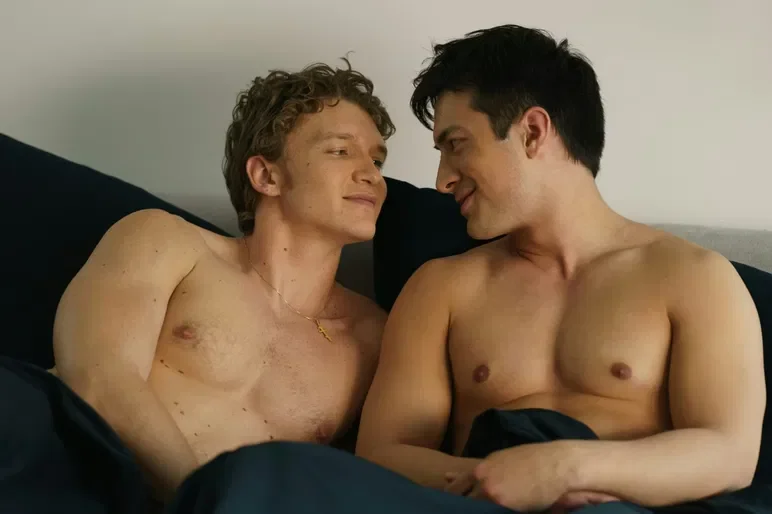
Image of Connor Storrie and Hudson Williams from Heated Rivalry Episode 6 on Crave and HBO Max
Decentering Erection
The intimate scenes in Heated Rivalry draw attention towards the eyes and details of the body that aren’t genitalia. This is so different than what has been normalized in gay culture. Freud would have loved how phallic-centric the gay community is. Many gay men have experienced shopping for penis size, color, shape, circumcision, or un-circumcision on apps like it’s Uber Eats.
The filming of Heated Rivalry is expanding the view of gay male desire. Full-frontal nudity didn’t need to happen in this show for gay men to see themselves in the characters during the intimate scenes. In the gay community, phallocentrism (centering on the penis) has been used as a distraction away from emotional investment. And with Heated Rivalry, that distraction was quieted, and romanticism took the center stage.
Phallocentrism is hurting MLM. It’s from this hyperfixation causes an expectation for having an insatiable sexual appetite in MLM culture. The unrealistic expectations for male sexual performance has contributed to the prevalence of PnP (party and play) in the gay community. Drugs are used to attain and maintain erection or anal sphincter relaxation to superhuman capacities. PnP pleasure comes at a cost however in having mental health and physical health repercussions.
When not using PnP, MLM’s awareness of their desires, emotions, and their bodies increases. It gives men the opportunity to slow down, check in with themselves, and listen to their bodies. Drug-free, gay intimacy is seen in Heated Rivalry, and that fantasy can become a reality for MLM.
Indefinitely Casual
Most MLM are not aromantic, but many pretend to be because of their conditioning as boys. Heated Rivalry pulls back that facade. The television show entering mainstream pop culture seemed to give men permission to finally open up about their romanticism.
Boys are taught at an early age to dissociate from their emotions so they bottle things up. Emotional suppression from an early age prevents men from having deep emotional awareness about themselves. The emotional build-up often shows up through avoidant behaviors. Pretending to be aromantic is one of those avoidances.
MLM may use hook-ups for emotional regulation. Casual hook-ups tease the psyche. Performance anxiety can be relieved by the permanent adrenaline with novelty of a new sexual experience with an unknown partner.
try to emotionally self-regulate in looking for a next hook-up rather than sitting down with an emotion wheel or journal to better understand themselves. Hook-up culture for emotional regulation isn’t a sustainable source of self-care. Casual, one-off sexual encounters tease the psyche from the performance anxiety, to the performance adrenaline, and then the after-performance release of tension and relaxation.
Intimacy allows for sex that isn’t performance based. While that can relieve the anxiety to perform, it can bring the fear of rejection. MLM may prefer to experience performance anxiety than the fear of rejection because of what they were told in childhood. Performance anxiety doesn’t challenge manhood in the way that the fear of rejection does. The mask or posture of patriarchy can still be upheld for performance anxiety, but the fear of rejection? Acknowledging that requires the admittance of vulnerability. And it is still widely believed in society that vulnerability is a feminine trait, rather than a human one.
Fear of rejection keeps MLM in a cycle of performance anxiety, adrenaline, and release in their sex lives. In Heated Rivalry, we saw MLM break the cycle. These men had to come to a reckoning that intimacy was more important than patriarchal performance.
When You Least Expect It
It’s often said that you find a partner when you least expect to. In Heated Rivalry, the men found their partners on a run, in a cafe, at work, and outside an ice rink. And yes, these random encounters that were found in Heated Rivalry simulated cruising culture, but there were key differences. These men weren’t anonymous to each other, and they maintained communication that extended beyond “wyd.”
When talking to elder gay men who have been happily partnered for decades, a lot of times they initially met, not looking for a life partner but someone to get them off. That one-off hook-up turned into more hooking up after exchanging contact information. And then they realized how safe their body felt with the other person. They learned that they didn’t need substances to sexually perform with that person because their body was being well-responsive to the intimacy that was being cultivated.
One-night stands involve dopamine-chasing, and after a while, it gets tiresome for the brain and body. When having partner-consistency, oxytocin is regularly being released. Kip making smoothies for Scott, watching Scott’s games with friends on the television, or sleeping in the same bed together as Scott all produce oxytocin for both Kip and Scott. Or take for instance, Shane and Ilya looking into each other’s eyes while filming the commercial, texting each other before hockey games, and playing a video game together on the same couch are also ways that oxytocin can be released.
Too many MLM know the pain of rejection by family members and friends where oxytocin was shared and then ripped away after coming out. Even when an MLM had a positive coming out with family and friends, these men still experience the vicarious, historical, or generational trauma of being rejected for who you love. When not addressing these traumas, MLM avoid producing more amounts of oxytocin.
Unhealed MLM limit themselves to treating other men’s bodies like dumpsters to discard their stress into. What MLM call “cum-and-dump”is a re-enactment of MLM historical trauma. Throughout history, MLM have been expected to dismiss love and care that they have for other men. Having brief, anonymous sexual encounters perpetuates the historical narrative. These men will not make time to develop a plausible romance in their minds or romantic encounters with other men because they have not processed what their fear of rejection means for them.
What You Really, Really Want
As the Spice Girls sang so articulately, “So tell me what you want, what you really, really want.” That’s what I want MLM to consider when asking, “Where’s my hockey player?”
I don’t think this is about hockey. This is about flipping the script of historical trauma for MLM. Heated Rivalry is causing men who use other men as dumpsters to subconsciously reconsider that pattern of behavior.
If you want to experience a relationship like Kip and Scott or Shane and Ilya, then it’s time to re-evaluate how you show up for other men. I want to offer some questions to journal about:
When having your first sexual encounter with someone, how are you going to make after-care together a priority?
Have you been on a first MLM date where having sex was not an expectation during or after the date?
How are you implementing self-discipline into self-care for yourself such as balanced nutrition, sleep scheduling, and exercise?
Do you go to gay clubs because that’s where you anticipate to find a compatible partner there, or because making a first-move in a mixed-gender or mixed sexual orientation non-club atmosphere feels more daunting?
Closing Note on Lingering Purity Culture
There are traces of Christian Purity Culture with men who restrain themselves from forming romantic connections with men they’re attracted to. Sexual shame stays contained to bedrooms, bathrooms, and clubs for these men, but to create a romantic connection without PnP? It seems as unrealistic as having a boyfriend who plays for the NHL.
While Heated Rivalry was written by a woman, I think there’s something MLM can learn from the story adapted to the small screen by Jacob Tierney. When men’s walls are down because of feeling safe, it’s possible to tap into their romantic, sweet playfulness. It’s possible to have a public, romantic MLM relationship that is filled with joy. Sometimes, we have to see the dream through another’s eyes to believe in the wonderful possibility.